Yesterday I watched “The Odyssey” in the movies. I actually liked the movie despite all the “adaptations,” but this will not be a movie review.
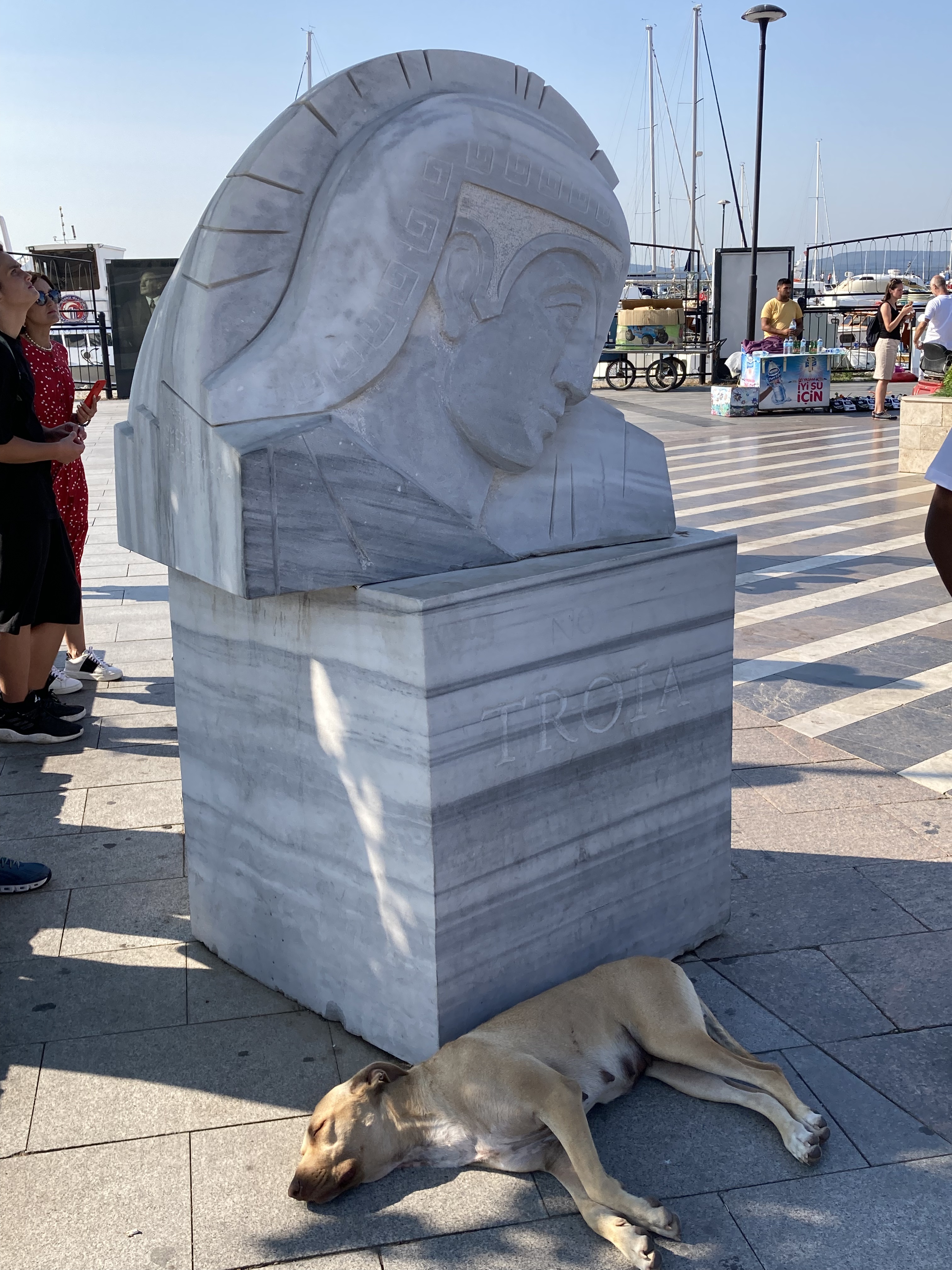
While watching it, I could not help thinking here we are with yet another Trojan horse. The film’s dramatic horse scene (for the latest “The Odyssey” production) may have been shot in Morocco, but in modern-day Troy-Truva, Turkey, I found myself staring at not one, but two suspiciously large wooden horses that looked like they were quietly plotting something. One is the classic locally built in the 1970s, standing guard at the archaeological site. The other is the Hollywood import from the 2004 Brad Pitt blockbuster “Troy”. Together they form the ultimate buddy-cop duo: one crafted from honest pine, the other from movie magic, steel, fiberglass, and whatever ego Brad Pitt was bench-pressing that year.
If you have never been to Troy, you should picture this: ancient ruins rebuilt, destroyed, and rebuilt again over millennia, now a UNESCO World Heritage site drawing nearly a million visitors annually. It is layered like a very expensive, very violent lasagna with nine cities (Troy I through IX) stacked atop one another across roughly 5,500 years. And right there, greeting you like oversized lawn ornaments from mythology, stand these two horses. One invites you to climb inside and channel your inner sneaky Greek soldier. The other looms in Çanakkale’s marina, brooding and expensive, whispering of Brad Pitt, Eric Bana and Orlando Bloom.
The real magic, and scholarly headaches, unfold at the archaeological park at Hisarlık, the Turkish name for the site of ancient Troy. In the 1870s, Heinrich Schliemann, the controversial German businessman-turned-archaeologist, “discovered” it while hunting for Homer’s city. He dug with aggressive enthusiasm. Well, some say destructive, because he was using dynamite in places, convinced he’d struck gold. What he revealed was far richer: a palimpsest of civilizations.
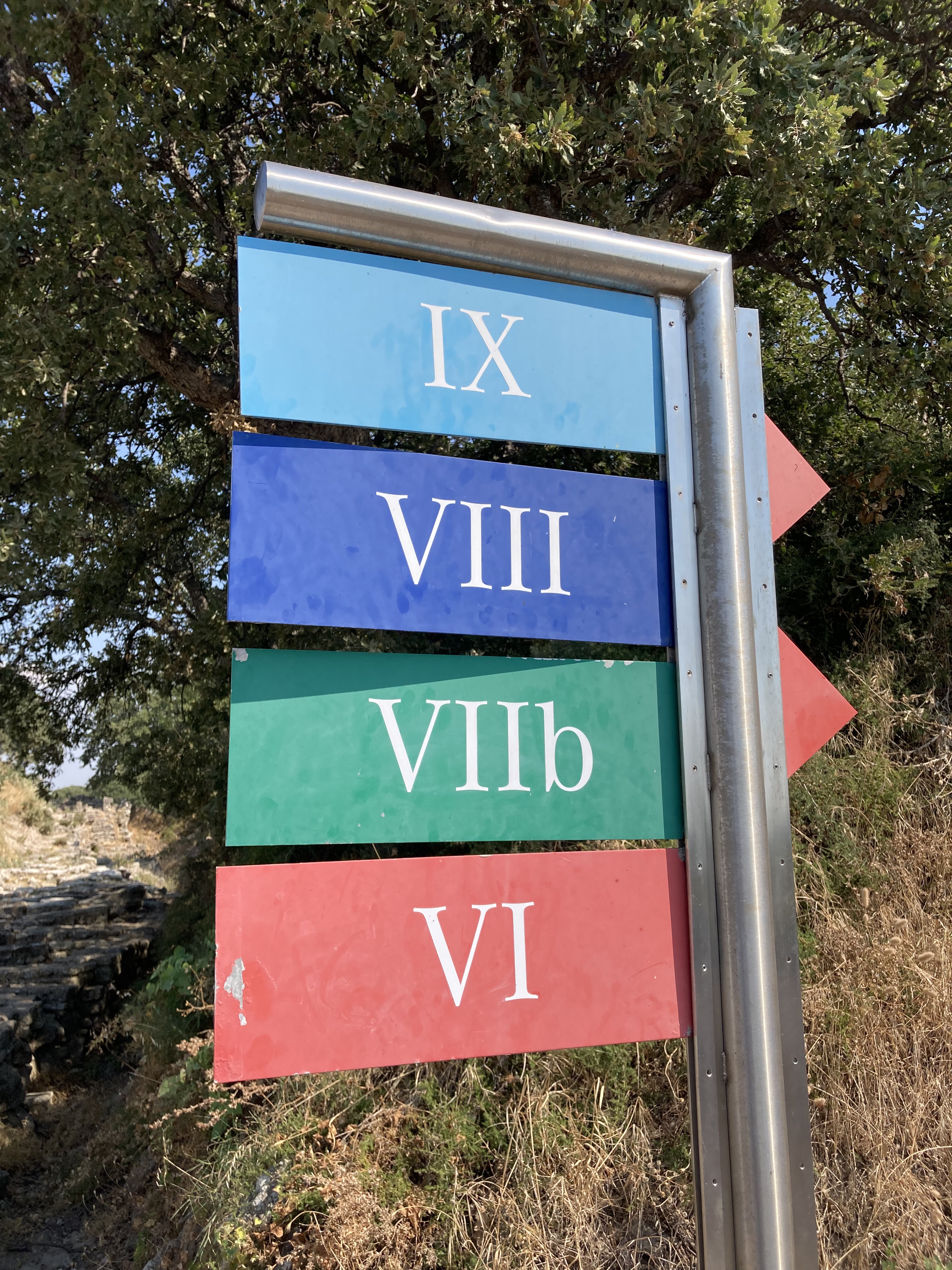
Troy I (c. 3000–2600 BCE) was a modest Early Bronze Age settlement with surprisingly strong fortifications. Later layers grew in size and sophistication. Troy VI (c. 1750–1300 BCE) is often the leading candidate for “Homer’s Troy” with grand walls, towers, and signs of prosperity suggesting it controlled vital trade routes between the Aegean and the Black Sea via the Dardanelles. Troy VIIa (c. 1300–1180 BCE) shows clear evidence of fiery destruction around the traditional date of the Trojan War (c. 1200 BCE), complete with arrowheads and other hints of violence. Subsequent eras added Greek, Hellenistic, and Roman (Ilium) chapters. Alexander the Great visited in 334 BCE, paid his respects, and left offerings. The Romans, claiming descent from Trojan refugees via Aeneas, poured resources into the site with temples and public buildings under emperors like Augustus.
Today, excavations continue under Turkish leadership, uncovering palaces, agoras, city walls, and treasures like a stunning gold brooch from Troy II. The site is not one dramatic ruin but a fascinating stratigraphic jigsaw puzzle. Walking the paths, you literally see how each era built upon or over the last. For me it was a humbling reminder that history is rarely tidy; it can be very messy, constantly rebuilt, constantly reinterpreted, yet captivating. The wooden horse replica near the entrance beautifully ties the ancient legend to this very physical place.
Let’s start at the beginning, because every good story about ancient deception needs context. The Trojan War supposedly erupted when Paris of Troy decided Helen of Sparta was worth stealing or eloping with. Ancient sources stay conveniently hazy on consent forms. After ten years of siege, the Greeks were bored, sunburnt, and out of patience. Then, enter Odysseus, the original chaos gremlin of Greek mythology. What was his plan? Build a giant wooden horse, stuff it with elite warriors, pretend to sail away, and let the Trojans do the heavy lifting. Literally. Troy felt that night.
The earliest references appear in Homer’s “Odyssey” (“Iliad” ends before the finale). Homer keeps it brief: “Yeah, there was this horse, Odysseus led it in, bad times for Troy.” The full dramatic treatment actually comes later in Virgil’s “Aeneid” where the horse had been presented as a peace offering to Athena, Trojans ignored the warnings (poor Cassandra and Laocoön with his sea serpents), victory celebrations, the Trojans dragged it inside the city impenetrable city wall, and the Greeks sneaked out at night to open the gates and conquer the city.
Many ask the question whether it the horse was real. Archaeologists say almost certainly not in the giant-hollow-statue-with-wheels form. No wooden remains survive (no wood does not last 3,000+ years in most climates), and unfortunately no contemporary Bronze Age records mention it. According to some materials Troy shows destruction by fire around 1200 BCE, with some arrowheads, but the horse itself is likely a mythologized memory of a siege engine, a ship with a horse-head prow, a battering ram covered in hides, or even an earthquake (Poseidon was God of both horses and quakes after all). Still, it remains one of history’s most enduring tales of love, war and deception. It even inspired the term for malware. Congrats, Odysseus! You invented cybersecurity threats.
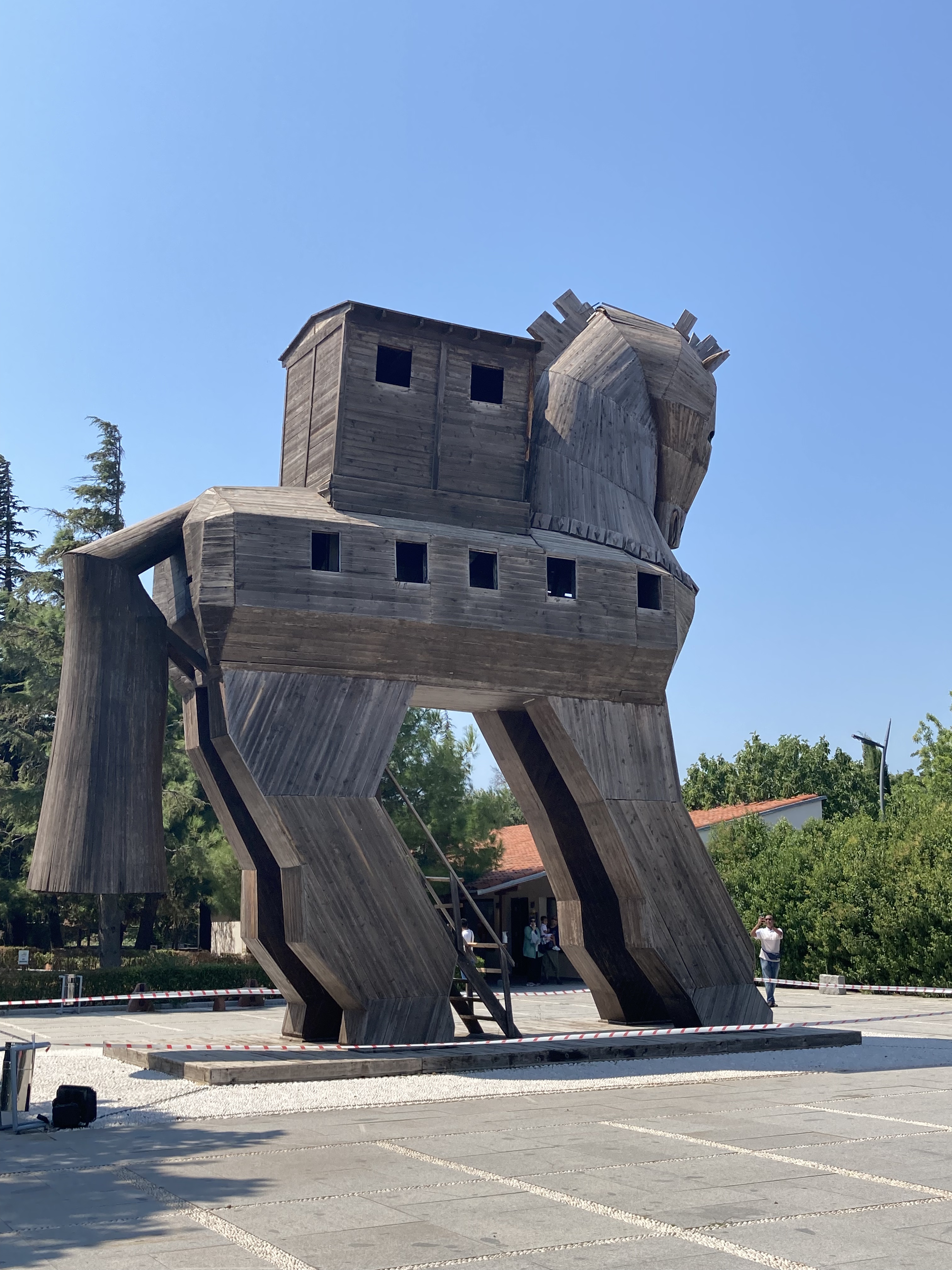
More than you’d expect for something that probably never existed. Ancient depictions include the Mykonos Vase (c. 675 BCE), showing soldiers climbing in and out. There were likely small votive models, theatrical props, and Roman recreations. In modern times, it’s become a full cottage industry. The local classic at the Troy site: proposal was prepared in the 1970s, built in 1974 from pine timber (no steel, which explains the recent restoration). About 15 meters high, fully climbable, and wonderfully authentic feeling. It’s weathered over the decades and was spruced up for its 50th anniversary. Then, “The Hollywood star”: the 2004 “Troy” production’s massive prop, gifted by Warner Bros. to Turkey afterward. It was made of steel and fiberglass, over 12 tons, roughly 12 meters tall, now proudly stationed in Çanakkale’s marina. You cannot climb inside, but perfect for selfies while imagining Brad Pitt brooding nearby. (I waited an hour. Brad never showed. I was disappointed.)
I arrived at Truva after my own mini-Odyssey: four hours in a minibus from Istanbul to Çanakkale, plus a ferry and another minibus. Our first stop was at the archaeological site. The wooden horse there feels honest and sizeable: weathered pine, solid, like it could have been built by Epeius himself with a Turkish forestry permit. I climbed the ladder inside, peered out the windows, and expected to hear the Greeks emerging, swords drawing, while the Trojans were resting after celebrations. The visit in the park stretched over two hours. I love ancient sites and history, but trudging around in the midday August sun tested my devotion.
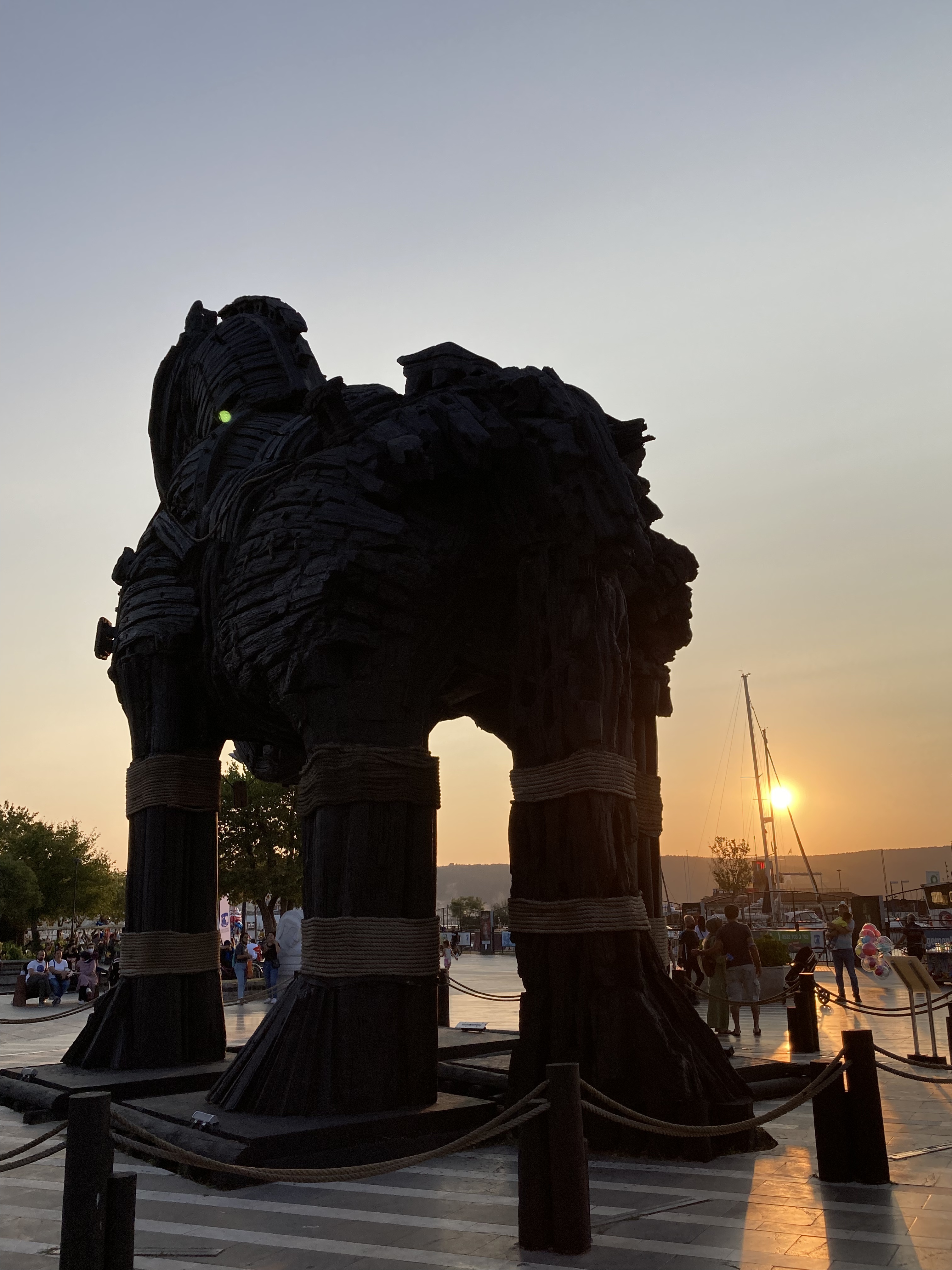
Then we headed to Çanakkale marina for horse number two. I must admit this is what I was waiting for and it was exactly what it offered: pure Hollywood. Bigger, shinier, more dramatic. It did not smell like pine, but it was like movie with huge budget and Brad Pitt’s personal trainer. It is still impressive. Standing beside it, you can almost hear the orchestral score swelling. I posed dramatically, squinting like Achilles, hordes of tourists snapped photos from dawn till dusk and local vendors sold Troy horse magnets for your fridge. Yet, I loved every second of sipping cold lemonade, sitting on a bench with a view of the Dardanelles, the marina, and the setting sun behind Brad Pitt’s horse.
The 2004 “Troy” film, directed by Wolfgang Petersen, took massive liberties with Homer. It compressed ten years of war into weeks, turning Achilles into a brooding action hero, and delivered a spectacular horse scene. It grossed nearly $500 million despite mixed reviews and cemented that iconic visual in pop culture. Eric Bana’s Hector, Orlando Bloom’s Paris, and those epic beach battles delivered pure sword-and-sandal spectacle. Pitt’s shirtless, oiled, intense Achilles became the face of the movie, with the horse as undisputed co-star. Gifting the prop to Turkey was a classy move – turning Hollywood prep into a beloved local landmark now watching over the Dardanelles. A side note, it is still one of my favourite movies 🙂
Coming back to Trojan horses. The contrast is delightful. One horse feels like a respectful homage to the ancient site. The other is a celebrity import that probably cost more than the entire ancient Greek war effort (adjusted for inflation and ego). Yet together, they are perfect bookends: myth and movie, history and hype.
Standing between these two horses in Truva, I felt the full weight of layered history: real archaeology, mythic storytelling, and cinematic flair, all converging on one absurdly memorable image. The Greeks won with deception. Modern Turkey wins with tourism. And I won with a slightly sunburnt neck and far too many photos of horse’s ass with sun setting over Dardanelles.

