The Kingdom of Cyprus was a medieval kingdom of the Crusader States that existed between 1192-1489. It comprised not only the entire island, but also had its foothold on the Anatolian mainland: Antalya (1361-1373) and Corycus (today’s Mersin Province, 1361-1448). Initially it was ruled as an independent Christian kingdom.

Cyprus under the Crusaders experienced significant changes that began with the island’s conquest by Richard the Lionheart in 1191 during his Third Crusade. Richard captured Cyprus from Isaac Komnenos, a Byzantine renegade who had declared himself emperor of the island. Richard wanted to turn Cyprus into a strategic base of operations and ensure safe supply lines for the Crusaders. Following his conquest, Richard sold Cyprus to the Knights Templar, who then resold it to Guy of Lusignan, the former king of Jerusalem. This transfer marked the beginning of the Lusignan dynasty’s rule. And with this, it transformed this little island into a crucial Crusader stronghold in the Eastern Mediterranean.
However, the Lusignan period was also marked by internal strife and external threats. The kingdom faced periodic rebellions and disputes over succession, weakening its political stability. Additionally, Cyprus was frequently threatened by Muslim powers, particularly the Mamluks of Egypt, who saw the Crusader outpost as a significant threat. Despite these challenges, the Lusignan rule endured until 1489, when the last queen of Cyprus, Catherine Cornaro, was forced to abdicate and cede the island to the Republic of Venice. This transition marked the end of the Crusader era in Cyprus, as the Venetians ushered in a new chapter of the island’s history, focusing more on trade and defence against the rising Ottoman Empire.
Several remnants of this period remain after the rule of the Crusaders. There three prominent castles built in the Girne (Kyrenia) mountain range, St Hilarion, Buffavento, and Kantara. These castles stand as enduring symbols of the island’s medieval history and strategic military architecture. I recommend visiting all of them. If one is a “history buff”, one will love the feeling of following the steps of Byzantines and then Crusaders. If not, then visit them to simply enjoy the breathtaking views of Cyprus. In general, the access to the castles is quite easy, well, except to Buffavento. There is a hike involved. It is not a long hike, but it can be exhausting under the scorching Cypriot sun. But once you reach the castle… enjoy the views and the breeze!

The easternmost castle is Kantara Castle located at the altitude of 630 meters above the sea level. The access is so easy. I parked the car practically by the main gate to the castle. But one thing that I have to stress here. While we were walking around the views were magnificent! They are stretching from the Girne (Kyrenia) Mountains, over Karpaz Peninsula to the east, and all the way to Larnaka located on the south-east side of the island. On the clear day, the shores of Turkey and Lebanon can be nicely visible. We were lucky that day with the weather and we could spot the Lebanese shores. Originally the castle was built during the Byzantine era, sometime after Cyprus was freed from the raids of Arabs. It was built on the peak of the mountain, with steep side rocky walls on three side of the construction. The entrance to the castle is from the east only. While approaching the rocky peak from the side of the mountains, it is difficult to spot the shape and the details. This is because it is hiding well between the rocks.
Interestingly, the first time Kantara was mentioned dates back to 1191, when King Richard the Lionheart caught up with his adversary, Isaac Komnenos. According to one of the sources, Komnenos took refuge in Kantara Castle after Richard the Lionheart had defeated him. Later he fled the castle and surrendered to the English king. It happened when Guy de Lusignan took over the Girne (Kyrenia) Castle. More information is from the Frank and the Venetian era from the period of 1191 – 1571. The fortification of the castle made it a vocal point of many conflicts during that era. Back then the castle was known as Candaire or Candare and it was practically impregnable by its besiegers. Unfortunately, Kantara Castle was later destroyed the Venetians.
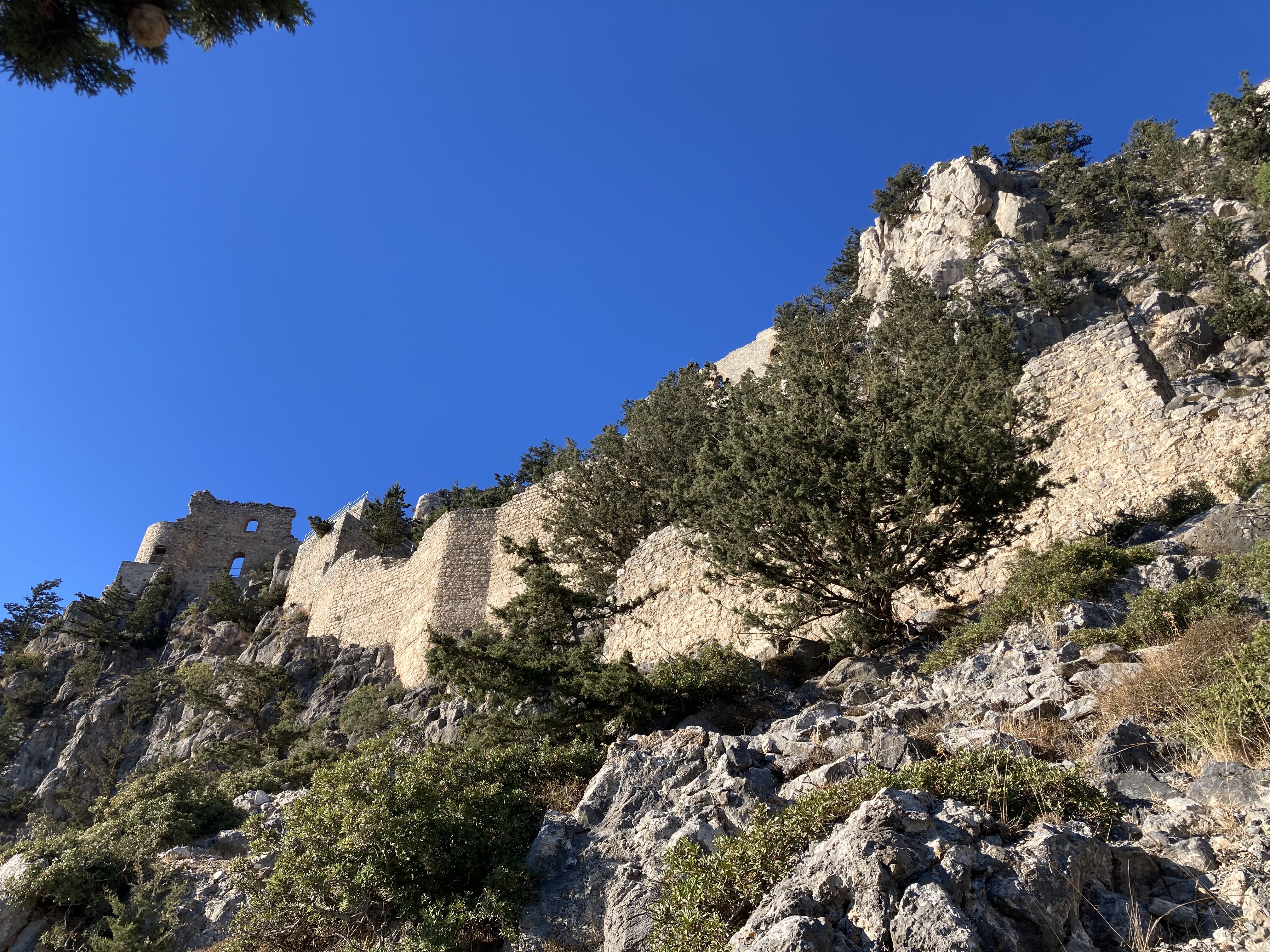
The second castle is Buffavento Castle, located on the Girne (Kyrenia) mountain range, between Kantara and St Hilarion castles. Its name, meaning “Defier of the Winds,” can be explained by the cold winter winds blowing from Anatolia. The name also reflects its strategic placement at approximately 950 meters above sea level. The walk up to the castle in the hot summer day may have not been the best idea. There is no tree to hide under, and there is literally no wind. The words coming out of my mouth while hiking, were not very “lady-like”:)) But once we reached the main gate… suddenly the aura changed. We had to “cross” to the north side of the mountain. I found trees, shade and cool breeze! Interesting point to mention is that the flora also changed. Everything was greener. And all this just by taking one step over the mountain ridge.
Going back to the history. The castle was originally built by the Byzantines in the 11th century as part of a defensive network, including the nearby Kantara and St Hilarion Castles, to protect against Arab invasions and later Norman and Crusader threats. In the past the bonfires were lit on top of the tower were used as means of communication with the garrison stationed at St Hilarion and Kantara castles. By the 14th century, as the threat of coastal raids diminished, Buffavento Castle gradually fell into disuse and disrepair. Its strategic importance waned with the changing political landscape and advancements in military technology. Today, the castle stands as a rather dramatic and picturesque ruin, however it offers spectacular views over this beautiful island.
The third and last castle on the mountain range is St Hilarion Castle. It is one of the best-preserved and most storied medieval fortification on the island. The drive to the castle is between the military training fields. There was a moment of doubt in my head weather we were actually going to find it. Good news! We did.
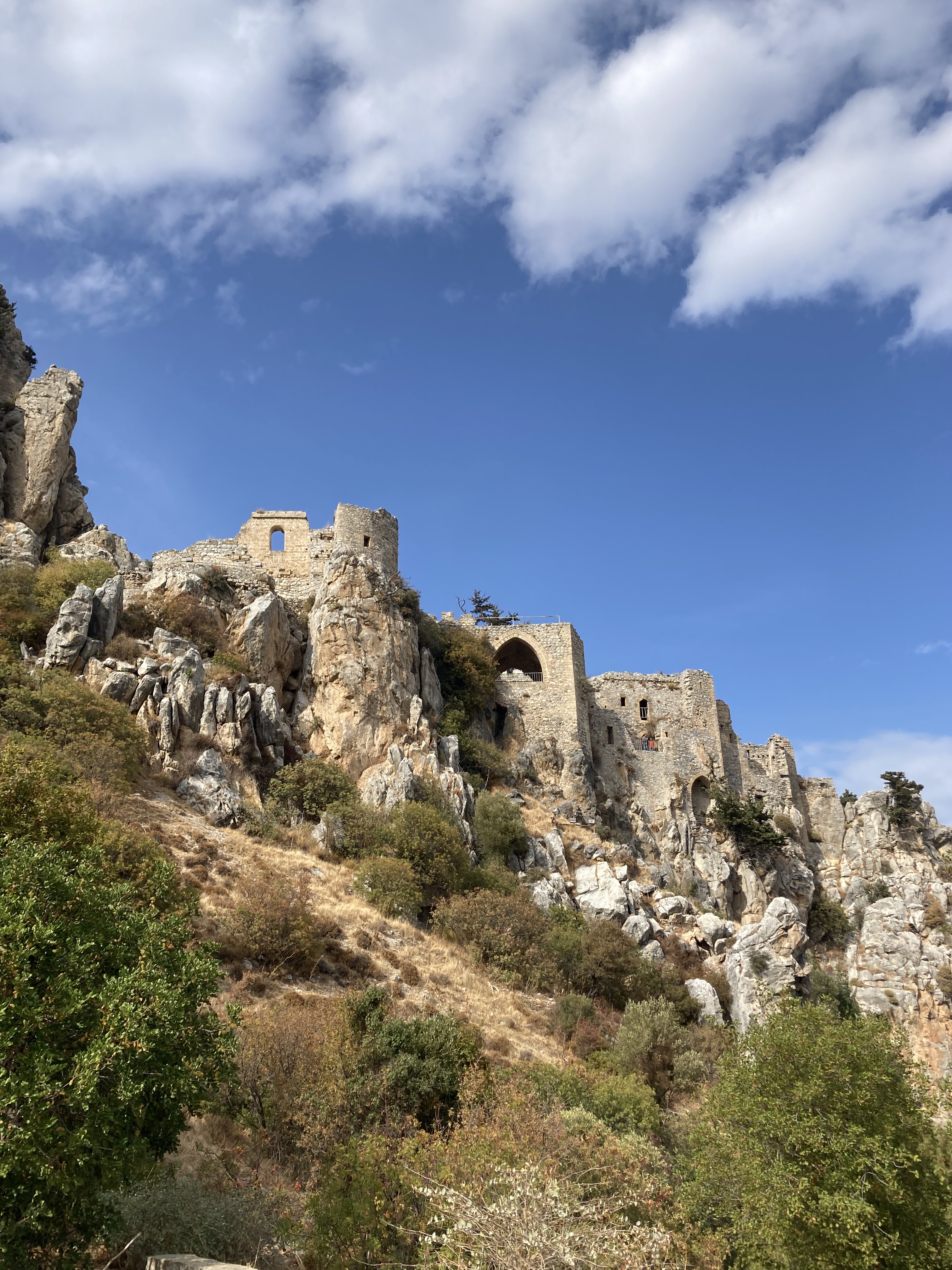
Its origins date back to the 10th century when it was initially established as a monastery dedicated to Saint Hilarion, who, according to some sources, was a Palestinian monk known for leading rather secluded life. The castle was strategically built on a steep hill to utilize the natural rocky landscape to create a strong defence against Arab pirates who frequently raided the coastlines of the Byzantine Empire. During the Crusader period, particularly under the Lusignan dynasty in the 13th century, this castle was significantly expanded and fortified. Amongst others, the outer fortifications were built and then strengthened. St Hilarion became one of the key defensive structures, along with Buffavento and Kantara castles. They formed a defensive triangle that safeguarded the island from constant invaders. The design of the castle design is yet another remarkable example of medieval military architecture. It is surrounded by thick walls, contains narrow staircases with numerous towers and battlements. It was divided into three main sections: the lower part for soldiers and horses, the middle part housing the royal family and church, and the upper part containing the keep and watchtowers.
It is worth mentioning that St Hilarion Castle also served as a summer residence for the Lusignan kings. Because it offers panoramic views of the surroundings and breathtakingly blue Mediterranean Sea. Its picturesque and favourable position inspired many legends. One of the theories is that it is the possible source of inspiration for Walt Disney’s castle in “Snow White and the Seven Dwarfs.” Over the centuries, the castle fell into ruin, particularly after the Venetian conquest of Cyprus in the late 15th century, when its military importance declined. Today, St. Hilarion Castle stands as a testament to the island’s rich medieval history and offers visitors a glimpse into the architectural prowess and strategic ingenuity of the Crusader and Byzantine eras.
 kasiasteps
Windy out there, huh? Thank you for the beautiful pictures and sharing a bit of a less known (at least to me) history.
LikeLike