The alarm ripped me from sleep at 4:45 AM in Bukhara and the pre-dawn chill sept through the hotel walls. It was way too early to get up but I had had quite an adventure waiting. By 6:30 we were at the train platform, clutching tickets for the 07:01 Bukhara – Khiva and waiting patiently for the train to arrive. Apparently, Uzbekistan’s railway gospel says, “it arrives when it arrives,” so the 12-minute delay felt like precision engineering.
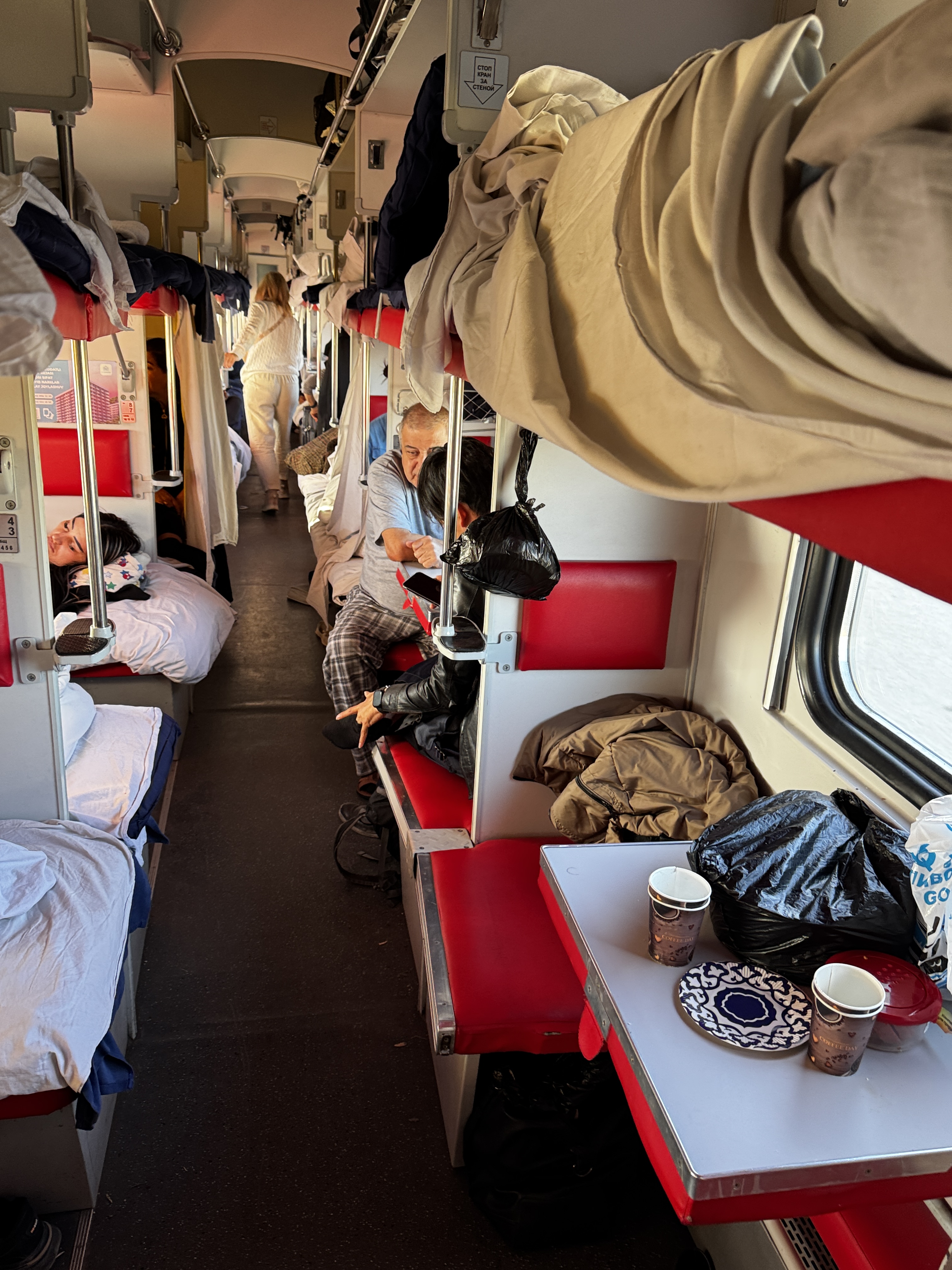
The train rolled in with a groan of iron older than most nations: greenish carriages scarred by decades of desert sun, windows sealed with rubber gone brittle, and the unmistakable tang of coal smoke drifting from the samovar corner. We queued to our wagon, the conductor in a peaked cap checked the tickets and we rolled inside with our luggage. My first thought was “time travel is real” – the entire wagon was open as a dormitory; six bunks stacked like shelves in a giant’s pantry in each part. Every new traveler got a travel-bag, as you can call it, fresh sheets—starched, hospital-white, were pressed into our hands. If one wanted some privacy, then it meant knotting them into makeshift curtains.
I was lucky one to draw an upper berth, which was practically a vertical assault course requiring one foot on the something in a shape of the step, a knee on the opposite bunk, and a silent plea that the train stay steady while I hauled myself skyward. Years of practicing yoga came very handy in that moment.

The heart of the carriage was the coal-fired samovar, a squat iron beast bolted to the wall at the end of the wagon. Every now and then the train attendant shoveled briquettes into its belly, the metal door clanging like a blacksmith’s hammer. Judging by the instruction manual written in Cyrillic alphabet, it looked like we needed an engineering degree to operate this machinery, but it worked so well. Water hissed, steam curled, and boiling water was ready to fill in the paper-cups with green tea bags. We made hot tea!
Outside the window that must have been cleaned months before, the Kyzylkum desert slid past in slow motion, kilometers after kilometers of sand and the occasional asphalt road leading to nowhere.
By 8:00 the carriage had transformed into a rolling picnic. Following local families traveling in the same wagon, wet wipes appeared on the used-to-be-foldable tables, thermoses hissed open, and foil-wrapped lunch boxes appeared as if conjured: sandwiches, boiled eggs, bananas, cucumbers, juices. All this, including the certain microclimate of the train, triggered instant nostalgia in all of us. “I remember…” type of stories from 1970s and 1980s PKP (Polish Railways) sleepers cascaded with the same game of balancing coffee while the train swayed like a drunk accordion. We had so much fun though. Laughter ricocheted off the dusty windows and metal walls as the samovar belched another cloud of steam.
Six and a halfish hour later, sometime before 14:00 local time, the views outside of the sandy window changed and the train entered the city of Khiva. Unlike polished grandeur of Samarkand or scholarly hush of Bukhara, Khiva feels like a living village that accidentally swallowed a kingdom. I was really waiting to get off the train and start exploring.

Khiva is the Silk Road’s only intact walled city: 2.5 kilometers of crenellated mudbrick, 10 meters high, enclosing an entire medieval capital where time genuinely stopped in 1873. No Soviet blocks, no blinking neon lights. There are only turquoise domes, carved cedar doors, local vendor owners calling you to buy socks “Model on Mongolia” or yet another shawl. I swear I could also hear the faint echo of caravan bells. Locals speak Khorezm Uzbek, a dialect so archaic that even Tashkent visitors may need subtitles; “r”s roll like camel hooves on gravel, and half the vocabulary vanished from dictionaries elsewhere. Women float past in atlas silk the shade of ripe figs, men in black-and-white doppi caps stitched with four tiny peppers. It is the ancient emblem of the Amu Darya’s four tributaries that once kept Khiva green.
The walled city known as Ichan Kala is stunning. The Tash Khauli Palace mesmerises visitors with iwan halls painted in lapis and gold, and a harem wing where 40 wives once spied through mashrabiya (type of an upper-floor window) lattices. The Kalta Minor minaret, sheathed in turquoise and emerald tiles, rises only 26 meters before it shears off. One of the stories says that the khan who commissioned what was supposed to be the Central Asia’s tallest tower died mid-build, and his heir pocketed the budget. The stubby, glittering half-tower is now Khiva’s accidental logo. Actually, it can be seen on every postcard and in every tourist brochure.
Every alley spill into a bazaar: stalls draped in pomegranate pattern scarves, shawls woven, local dolls, wooden phone or book holders, and handmade wool slippers curled like elf shoes in different colours and sizes. Whenever you ask for a size, you will hear “it will fit”. But what caught most of our attention were the stalls with towering above the piles of “camel wool” socks with the men’s chugirma hats, black sheepskin or white cones the height of a teapot, worn tilted rakishly to signal “I am Khorezm, and I remember empires.”

Khiva is also known for its wooden products, and we discovered beautiful wooden phone and book stands, hand-carved by local masters from walnut and mulberry. Each one was a mechanical miracle: with a few secret twists and slides they unfolded into five, seven, sometimes ten different angled holders for phones, tablets, or open books. We watched the old artisan demonstrate the sequence. It was almost hypnotic, yet the moment we tried it ourselves we fumbled hopelessly. I managed to shoot an “instruction video”, but still it was a “no go”. Honestly, solving a Rubik’s cube blindfolded felt like child’s play compared to remembering which panel to push, pull, or spin next. Ten minutes later we were still stuck on “how did he do that” while the older gentlemen laughed, then tapped two hidden corners, and the whole thing snapped smoothly into perfect position as if it had never dared to disobey him.
Hidden between the countless stalls is the Juma Mosque’s forest of 212 carved elm columns, some dating to the 10th century and each one in a different height because the builders used whatever caravan timber drifted down the river. Standing among them felt like walking through an ancient orchard frozen in time. The dim light filtered through tiny skylights, and I thought how these have outlasted Mongols, Timur, tsars, and Soviets; only the Aral Sea’s retreat threatens them, turning the once-lush delta into salt flats that creep closer every year. Originally, built in the 10th century over the ruins of an even earlier Zoroastrian fire temple, the mosque was razed by Genghis Khan in 1220 and painstakingly rebuilt in the late 18th century by Alla-Kuli Khan, who salvaged whatever ancient columns had survived the Mongol fire and centuries of neglect. Those mismatched pillars, some are still bearing faint pre-Islamic lotus motifs beneath later Arabic calligraphy, still stand as a quite witness to changing times and rulers.
The bazaar’s far end opened onto the slave market—domed, cool, and mercifully empty of chains. Until 1873, Khiva was the last great slave entrepôt of Central Asia; Turkmen raiders sold Persians here for salt and silk. Today the cells house workshops where grandfathers teach grandsons to embroider the geometric suzani that once paid ransoms.

Our visit to Khiva turned out to be perfectly timed too, as we unexpectedly stumbled upon a television crew filming what looked like a lavish period drama right in the heart of the ancient city. Every few minutes, a soldier or a “local ruler” in full historical regalia would sprint from the set straight to the catering tables for a quick snack or glass of water, then dash back without breaking character. We watched crew members carefully sweeping away carpets and decorations after a harem scene shot inside one of the actual historic places. It was such an odd feeling and the blend of real history and cinematic make-believe felt surreal, as if we had wandered onto the set of a time-travel movie where the past and present were filming their own collision in real time.
Six hours of clattering iron had carried us not just 300 kilometers but several centuries deep. In Khiva the past does not whisper, it grabs you by the collar and refuses to let go.
 kasiasteps