Uzbekistan is a captivating blend of history, culture, and flavors that hits you like a whirlwind of turquoise tiles, fragrant plov, and relentless carpet sellers they could sell sand to a camel. I recently returned from this Central Asian jewel, clutching four cashmere shawls I did not know I needed until the bazaar vendors worked their magic. As a kid, I was obsessed with the mystique of the Orient, tales of silk-filled caravans, spice-scented bazaars, and minarets piercing the sky fueled my imagination. Samarkand, the dazzling heart of those childhood dreams, was my must-see destination.

Country’s past stretches back to the Silk Road, the ancient world’s trade superhighway, launched around the 2nd century BCE, stretching for approx. 6 400 km from China to today’s Turkey, ferrying silk, spices, tea, and bold ideas across deserts and peaks. Uzbekistan was its vibrant core, a crossroads where cultures mingled and fortunes were won or lost in heated haggling. Samarkand shone as the glamorous hub, where Persian, Indian, and Chinese traders bartered goods, stories, and likely a few dubious camel deals, while Bukhara, the intellectual powerhouse, radiated as a center of learning and trade, dubbed the “Dome of Islam” for its scholarly prestige. Caravanserais (Persian “kārvānsarāy“, kārvān “caravan” with -sarāy “palace”, ancient rest stops for weary travelers and their cranky camels) still stand, some are reborn as museums or boutique guesthouses, that make you wonder whether a camel will check in with satchels tied to its two humps. Some of those are stand tall by the highways and remind about the proud caravans’ days.
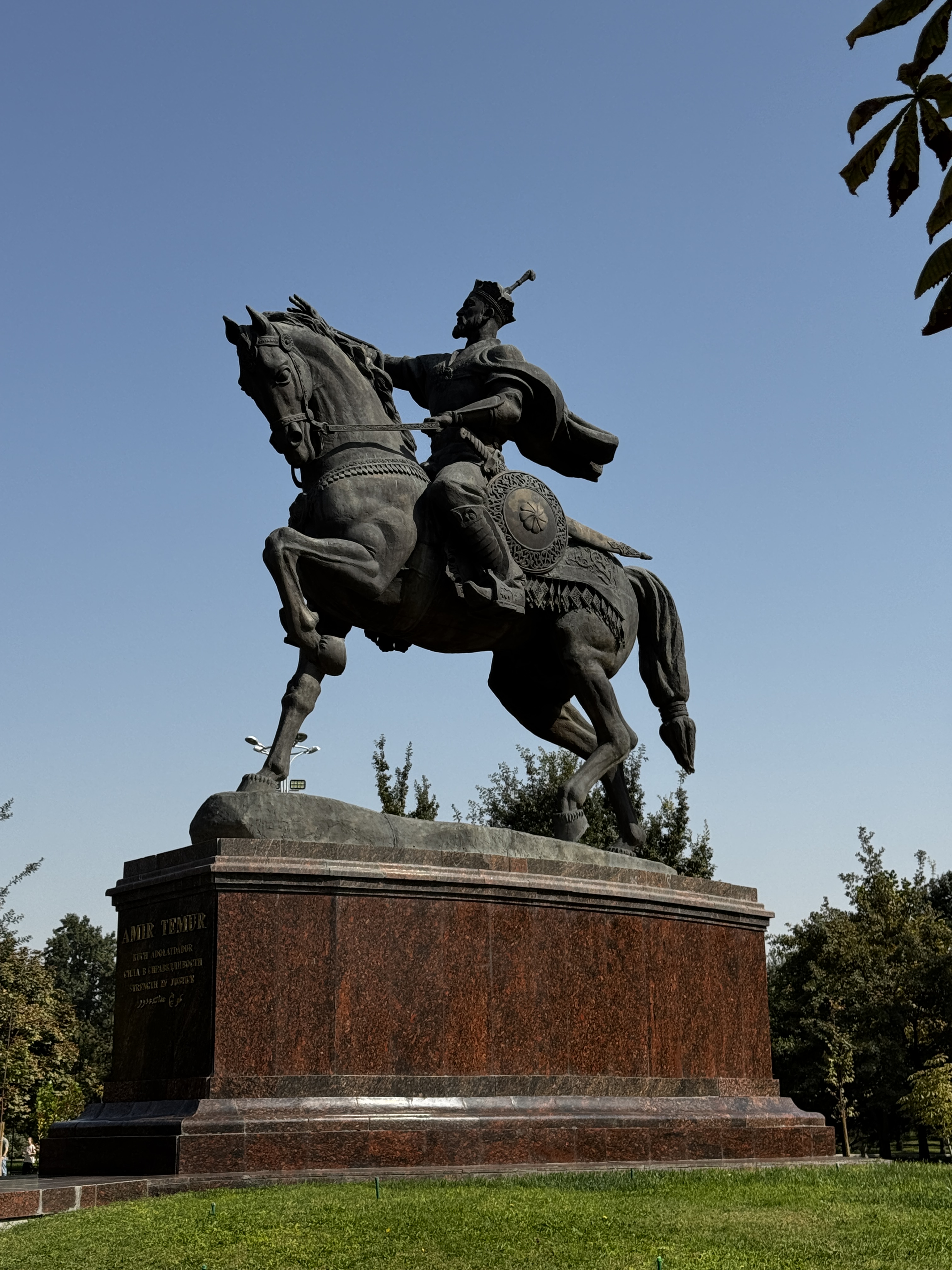
Enter Timur, the 14th-century conqueror who did not just build an empire from India to today’s Turkey. He built it with serious flair. Known as Tamerlane to some, he made Samarkand his capital and transformed it into a showcase of architectural splendor that screams “I am a warrior, but I’ve got taste.” His obsession with beauty meant dragging the best artisans from his conquests to craft buildings that still make your jaw drop. He built mosques and mausoleums so grand decorated with intricate carvings they feel like they were designed to impress the gods themselves. Timur’s legacy is etched in Uzbekistan’s skyline as a reminder that even ruthless conquerors can have a soft spot for a well-placed tile.
Samarkand was everything I had dreamed. Its streets felt like stepping into a Persian miniature painting where with history whispers from every corner and minaret. The madrasas (Islamic schools turned architectural masterpieces) are decorated with intricate tiles in every shade of blue, turquoise, and then more shades of blue, swirling into geometric patterns that could even hypnotize a mathematician. Many of them had been meticulously renovated and their faded facades restored to a glory that, honestly, may rival their medieval heyday. Whenever I stood among them, I felt small but utterly mesmerised.

The pinnacle of architectural splendor is found in Samarkand’s most iconic spaces. Registan Square in Samarkand is the crown jewel. My dream came true. It is literally a jaw-dropping plaza flanked by three grand madrasas that could outshine any cathedral. Ulugh Beg’s madrasa, named for Timur’s astronomer-king grandson, stands proud with its scholarly vibe, while Sher-Dor breaks all the rules with Persian-style lions roaring on its facade. Tilya-Kori, dripping in gold inside, feels like it was built to make you gasp. During the day the Square is flooded by international and local tourists and is used a s background to wedding pictures. However, in the evening at 9 PM, a light show transforms the square, with lasers dancing across the sky and tiles to narrate Uzbekistan’s epic history. Think about a spectacle that is half history lesson, half Vegas extravaganza with rather over-dramatised narration. I stood there with my phone in my hand, my new cashmere shawl draped around me, thinking that this beats any Netflix series binge-watching any day of the week.

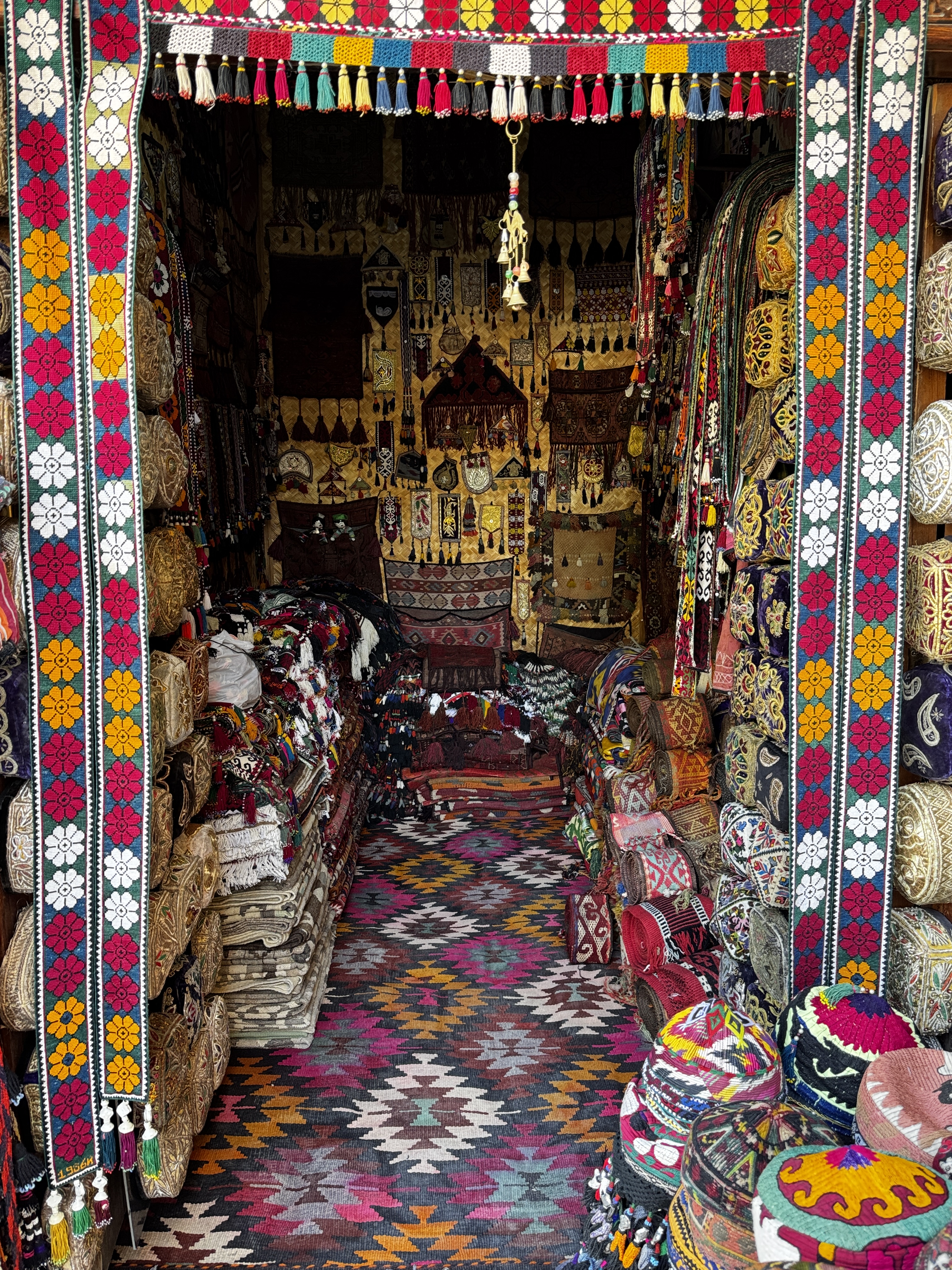
The next destination on my route was Bukhara with its Old Town, a UNESCO World Heritage Site. Travelling from Tashkent to Samarkand and Bukhara was like travelling back in time – it was like stepping into a time machine, but with better plumbing and Wi-Fi available in hotels. Its labyrinth of ancient mosques, minarets, and markets felt frozen in time and every corner whispered a story of Silk Road glory. The real challenge, however, was dodging the carpet and scarf sellers. Wool, silk, cashmere, they’ve got it all, in different colours, shades and patterns. I haggled for every single cashmere shawl and scarf. At the end, I left the country with four, each softer than the last, proof that local vendors are the true to their nature (a huge “thank you” to my Other Me who taught me the art of haggling:)). It is truly a place where history and commerce dance, and you are swept along for the ride, your arms loaded with various textiles as a result.
Living in different cities and countries I started paying attention to strange things, like how clean the streets are, and I was fascinated how each Uzbek city gleamed with such pristine cleanliness that dropping a crumb seriously felt like committing a crime. From early morning municipality employees were moving constantly brushing the streets, pavements and even lawns. Another thing for me was to compare metro stations. The ones in Copenhagen or London are rather boring-looking, those in Istanbul are colorfully decorated. And there are stations in Tashkent. They were turned into a work of art. Local metro stations are a visual feast; one decorated with cosmonaut murals that pay homage to the Soviet space race, another featuring lights shaped like cotton buds, a wonderful nod to the country’s cotton heritage. But, the traces of the Soviet era still linger in the sweeping boulevards, stoic statues, and a subtle bureaucratic air, as if communism sneaked into a Silk Road celebration. It seems that this quirky fusion of ancient Oriental splendor and Soviet rituals blend here seamlessly.
Travelling is not complete without the food. Before leaving for Tashkent I spent some time reading (and getting ready) what one should eat there, Plov is the national Uzbek’s dish. I cannot say it is for people who are on a diet or prefer “lighter” food as it is cooked in lamb fat, but oh, it is so tasty! It is a rice pilaf elevated to an art form with regional rivalries fiercer than a cooking show on Foodnetwork. In Tashkent, plov is a masterpiece, cooked in a massive pot that could easily double as a hot tub, with raisins adding a sweet twist and tender lamb crowning the heap. Samarkand’s version is all about layers—rice, two kinds of carrots, spices and beef stacked like a savory wedding cake, skipping the raisins for a more restrained elegance. Bukhara swings back to lamb, serving a rich, aromatic plov that fuels you for hours of wandering. I sampled them all, but each bite was a delicious lesson in Uzbekistan’s culinary diversity. Add to it, the season’s red and juicy pomegranates, bursting with tart sweetness, piled high in every bazaar I went to. Their ruby seeds squeezed to fresh pomegranate juice right there in the markets was a refreshing revelation. Every cup felt like a perfect addition to a day filled with history, haggling and local food.
I admit that Uzbekistan stole my heart, expanded my waistline, and fed my lifelong fascination with the Orient’s magic. From the turquoise glow of madrasas to plov and breads that change with every city, it’s a land where history, hospitality, and a touch of Soviet quirkiness mix together. The streets hum with caravan stories, the food comforts you at any time of the day and the carpet and scarves sellers remind you to pack your bargaining skills – mine were put to a very good use, judging by my cashmere shawls and several other items neatly packed in my luggage.
 kasiasteps