What do you do when you binge-watch “Sopranos” again? You book a flight to Napoli, or Naples, if you will.
The Other Me and I had this overwhelming need to go back to Italy and Tony Soprano convinced us that it was time to go back. With less then 2hour flight from Istanbul it is a shame not to pop-in to Bella Italia for a short break. Once the flight tickets were in my inbox, I went ahead and booked us a visit to Pompeii.
I had always wanted to see this ancient city. The idea of a city frozen in time, covered by volcanic ash from Mount Vesuvius, feels like something taken out of a novel. But it happened, as we all know. In 79 A.D., Vesuvius erupted with terrifying force, burying Pompeii, Herculaneum, and several other towns beneath layers of ash and pumice. Thousands died. Homes, streets, even meals on tables were covered by lava or hot ash. It was a terrible disaster, yet one thing is for sure: an entire civilization was preserved in the most intimate detail.
There’s something undeniably surreal about standing face-to-face with the past, don’t you think?
Walking on the streets of Pompeii is an unforgettable journey into the past, like you are stepping into a different world. This was the visit that offered a glimpse to life the grandeur and tragedy of the ancient Roman world. Situated near modern-day Naples, Italy, Pompeii was a thriving city until that tragic day following the catastrophic eruption of Vesuvius. For centuries, the city lay frozen in time, only rediscovered in the 18th century. According to our guide today 44 out of 66 square kilometers of the city is already uncovered, and I can tell you, it is stunning.

For me Pompeii does not just show what was left from this once magnificent place, it shows what the daily life was like. It makes the tragedy of Pompeii deeply personal. These were created by pouring plaster by archeologist into voids left in the ash where bodies had decomposed, these forms capture people in their final moments. Before the technique was developed, human remains were found as they were, embedded in the hardened ash; skeletons discovered in kitchens, streets, baths, even clutching one another in doorways. One of the most heartbreaking finds is the cast of a dog, its body contorted in panic, trapped by a leash that prevented its escape. Seeing them – bodies of people and animals caught in final horrific moments – made my heart stop. Mother trying to protect her child, another person covering their face, chained dog unable to run away.
Their expressions and positions tell a silent story of panic and helplessness, making the tragedy feel very real. I must admit, I glanced few times at magnificent Vesuvio, checking whether it was still peacefully asleep. When you see these victims, you cannot help but think it is not just history; it is truly a heartbreak.
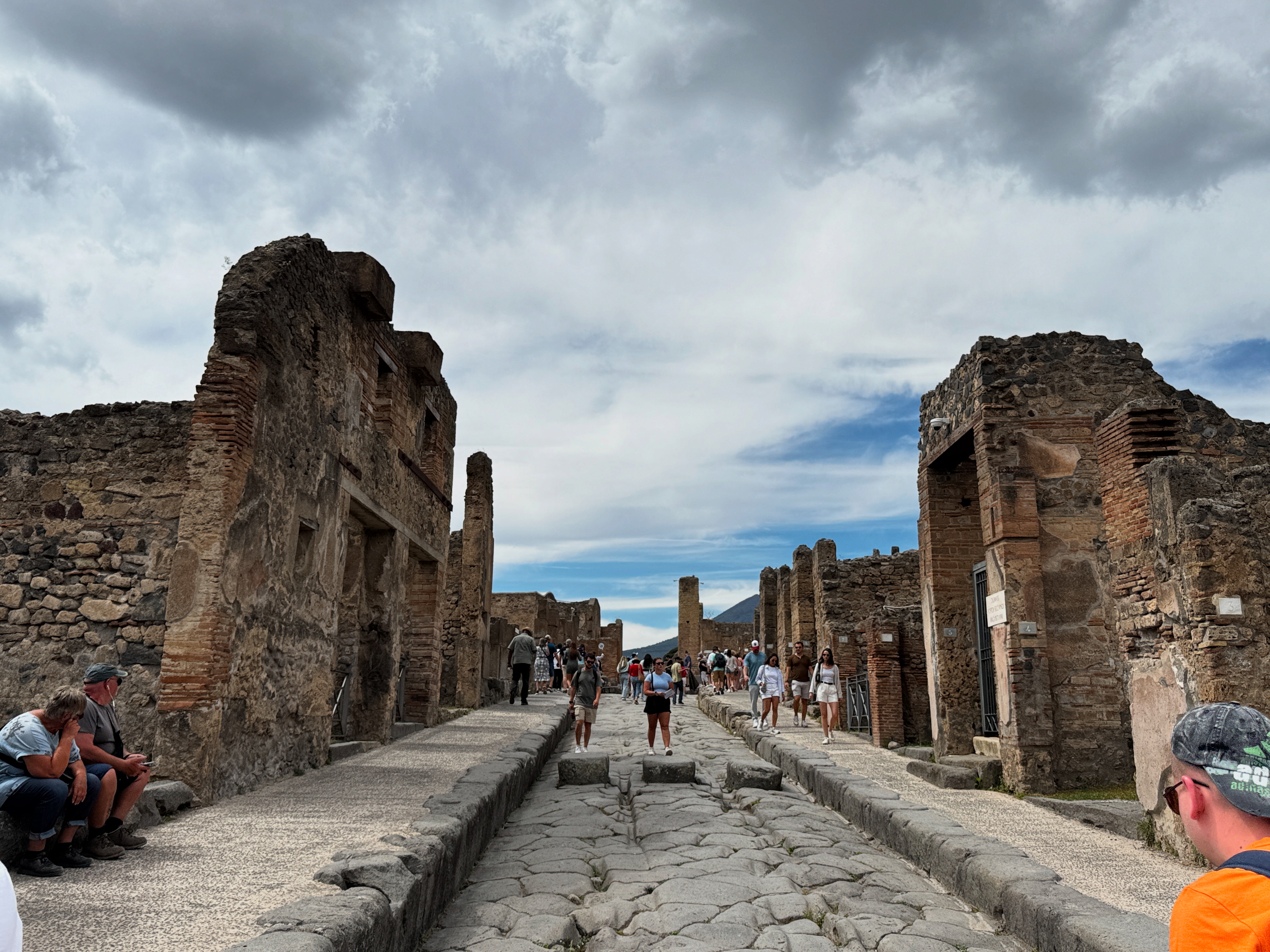
Walking through Pompeii’s stone-paved streets, you can see the grooves worn into the roads by ancient carts and the stepping-stones used by pedestrians to avoid flooded pathways. Ingenious in so many ways. There are thermopolia, where you can visit small street-side food shops with marble countertops still intact, their circular holes once holding pots of hot food. The Roman version of takeaway, you may say. You almost expect someone to step out and offer you a ladle of stew.
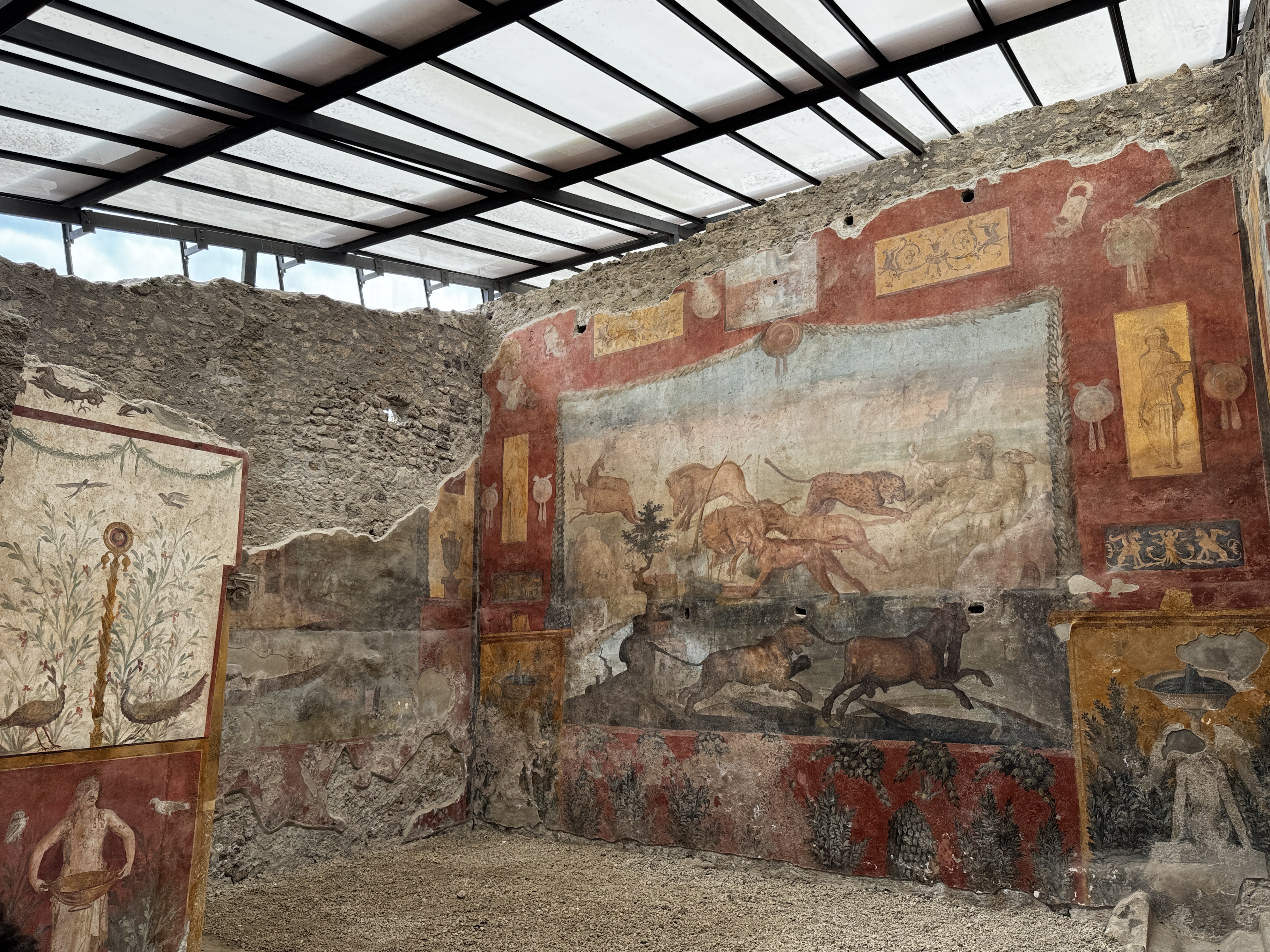
What truly brings the city to life, though, are the houses. In the residential quarters, you’ll find the grand homes of wealthy Romans, many with walls still painted in vibrant frescoes—scenes of gods, banquets, landscapes, or mythological tales. These weren’t just decorations—they were statements of culture, power, and taste. Some houses even have graffiti on their outer walls declaring the homeowner’s political alliances—slogans supporting electoral candidates, scratched into plaster like ancient campaign posters. Others contain more personal scribbles: jokes, love notes, or insults. These small details make it easier to imagine the people who once lived there.
Unlike other ancient ruins, where only scattered stones remain, this place still offers a complete city layout. You can explore homes, temples, bakeries, baths, theatres, and even brothels – each offering a glimpse into the daily lives of its former inhabitants. The Villa of the Mysteries, with its vividly preserved frescoes, is particularly breathtaking, showing the artistry and mystery of Roman culture. The Forum, once the bustling centre of public life, still stands with its colonnades, surrounded by administrative buildings and temples that hint how important that city once was.

Then there’s the city’s more carnal side. One of the most visited sites is the Lupanar, Pompeii’s main brothel. The small building contains seven tiny rooms with stone beds and erotic frescoes painted above each doorway. You can say it was visual advertisements of services offered in this particular establishment. The frankness of Roman sexuality stands in contrast to modern prudishness, and the openness is both funny and oddly moving. There’s no shame here – just life, as it was.
The Naples Archaeological Museum completes the experience. It houses much of what was excavated: delicate jewellery, bronze statues, glassware, everyday utensils, and stunning mosaics. One gallery holds items so personal—a comb, a child’s toy, a cooking pot—that you can’t help but imagine their owners. And then there’s the infamous Gabinetto Segreto, or Secret Cabinet, where erotic artefacts from Pompeii and Herculaneum are displayed. There are phallic wind chimes, fertility amulets, and risqué frescoes from brothel walls. Let’s just say the ancient Romans were far more relaxed about these things than we are today. I definitely heard a few giggles.
And yes, I do have Pompeii’s lucky charm as a pendant😊
 kasiasteps